A fiery breath of fresh air.
Dragon's Dogma is not made for first impressions. The flaws are visible within the first hour—the dated character modeling, minor clipping, lip-synching issues, and party members constantly blurting dialogue over each other. Then there's the chance that you find the combat too challenging, the music too ambient, the NPCs too plain, and the story too vacant. The reasons for prematurely ejecting the disc are numerous, but if you're able to withhold your judgments for little more than three hours, you'll find that Dragon's Dogma is an amazing realization of one of the best new ideas to come from Capcom, let alone Japanese developers, in an excruciatingly long time.
Understanding the design behind Dragon's Dogma means dutifully noting its influences, first and foremost being the popular but infamously difficult Demon's Souls and the second being the open world of The Elder Scrolls series. Somewhere in between the two sits the medieval world of Gransys, comprised of continuous areas with paths clearly outlined by mountain slopes and seaside cliffs. Dungeons, castle ruins, pickable herbs, and a whole bestiary of threats pepper the landscape, all waiting to stop you in your tracks.
This picturesque world isn't as punishing as the kingdom of Boletaria in Demon's Souls, but only if you're careless. The first open field may be littered with grunts that are meant to be fodder, like goblins, rabbits, and seagulls, but strut into the next field with too much confidence and a group of armed bandits can slice you and your party into a quick game over. And they're just the tip of a very nasty iceberg.
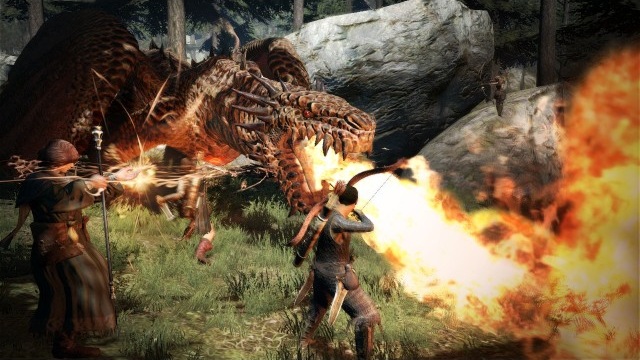
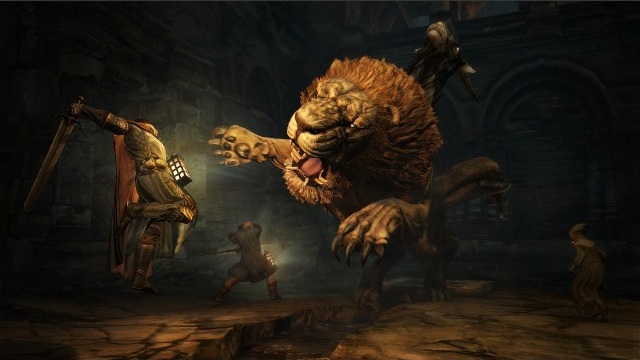
Dragon's Dogma has no qualms about shutting you down if you get a case of wanderlust and will gladly toss in a cyclops, ogre, chimera, or some other beast at least fifty times your size just to remind you who's in charge. These gargantuan bosses can swipe off huge chunks of your health bar with one clean hit, or if they fancy the thought, grab your sorry ass two hundred feet into the air and let gravity do the rest. The dragons in particular are awe-inspiring beasts with a wide arsenal of well-animated attacks and movements that put the Skyrim dragons to shame. Having one save slot only makes them that much more terrifying.
That said, getting yourself hit is almost always your fault, whether it's not planning ahead, ignoring your health or stamina, getting yourself surrounded, missing an attack that leaves you open, or walking into an area that's obviously not meant for your character's level. Every action and decision you make counts. No enemy is impossible to defeat given the right strategy and enough tenacity. A large gathering of lightweight enemies can be taken out one by one by knocking them down or attacking from a distance. Bosses can have elemental weakness or vulnerable spots on their body that you can exploit, usually by grabbing onto the boss itself a la Shadow of the Colossus, and stabbing weak points until the boss topples over for some free critical hits. (For more tips, check out my guide!)
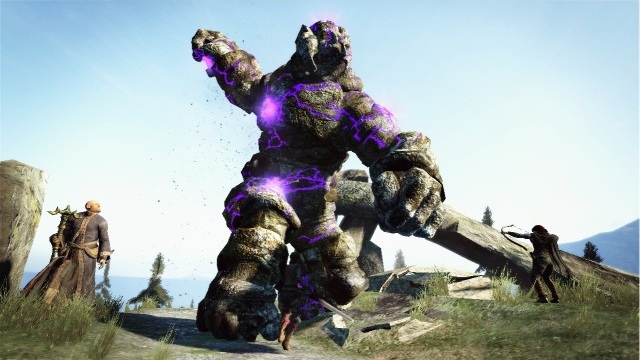
Complimenting this is an incredible level design that rewards exploration and keeps you wanting more despite the unknown threats lurking in the distance. Though the undulating landscape doesn't extend like it does in Skyrim, its sheer breadth is still inspiring and immersive—sometimes even more than Skyrim. Every dungeon and castle in Dragon's Dogma is original, rarely using any level pieces more than once, while incorporating curved pathways, heightened steps, and plenty of nooks and crannies. If it looks like you can grab onto an obscure ledge or follow a narrow bluff to the edge, you usually can. And there's often a treasure chest waiting for you. With so much content, the graphical flaws become forgivable in the long run.
The strength of the combat and exploration cannot be understated as they lie at the core of why the story isn't as emphasized here (nor in this review) as it is in other fantasy RPGs. Indeed, the game even begins with a combat tutorial sequence, though the introductory cut-scenes that follow soon after are joltingly dramatic: In what seems to be a ritual that repeats itself over many generations, an evil dragon descends onto the human world spreading destruction and a horde of monsters. This time, it appears off the coast of Cassardis, your hometown, and though you attempt to thwart it, the dragon easily defeats you, pricks your heart out, eats it, and spews some draconic mumbo-jumbo until you pass out (thinking that you're Dennis Quaid). Strangely, you awaken without a heart, and now must follow your fate as an Arisen, destined to face the dragon once more.
From that point onward, however, the story only comes in vague pieces spread out by lengthy quests and side missions, as if it's strung along like a third wheel. NPCs, despite having coordinated tasks throughout the day cycle, normally don't have more than one line of dialogue. It's a shame because the dialogue itself is actually well-crafted, with attention to language and decent voice-acting that pulls it off. In all likelihood, the general lack of emotional attachment is meant to highlight the combat and exploration, but it's still a missed opportunity. Gransys feels more like a gorgeous combat arena rather than a living, breathing world.
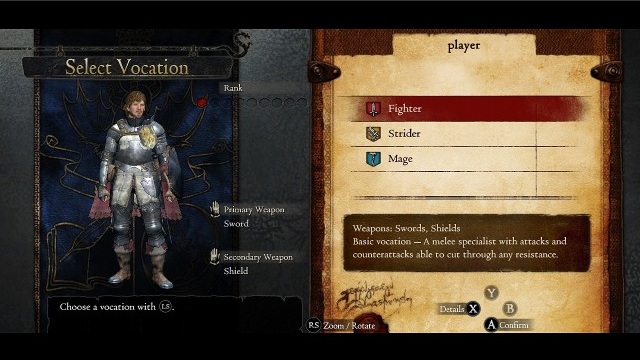
Then again, this approach fits within the Demon's Souls aesthetic. The motivation is centered less around story and more around building a character, earning experience points, skills, and equipment, for the next challenge to come. Character customization is incredible from the very start, offering a vast number of options that almost rival the editors in WWE titles (crossdressing, anyone?) and can be changed once you reach the city of Gran Soren. There, the initial class selection of fighter, rogue, and mage in Cassardis suddenly expands with the ability to choose from an additional three advanced classes and three hybrid classes. On top of that, you can switch between these vocations at any inn, and any augments or compatible techniques carry over.
The pawn party system for Dragon's Dogma also seems inspired by Demon's Souls in how other players can impact your single-player adventure, though in a much more direct way. The Arisen, having the sacred privilege of controlling a human-like race called Myrmidons, can form a party of three pawns. The first is your main pawn, who you create from scratch just like your own character, whereas the other two are main pawns created by other players and found by entering a foggy realm (much like Demon's… okay, you get it) accessed by touching a Rift Stone.
This might sound like an overly forced way to inject a pseudo-multiplayer mode, but it's integrated extremely well. Whenever your main pawn is hired by another player, he or she returns with extra goodies, experience, and rift crystals that are mainly used to hire pawns who are higher than your level. At the same time, since these hirelings don't earn experience like your main pawn, you need to search for new hirelings often. It's a mutually beneficial system that involves you without wringing your neck.
If that weren't enough, the lasting value of Dragon's Dogma is almost limitless with the level cap well past 100, an end-game that continues after the final boss, and plenty of loot and equipment to acquire. Items can be combined together to form new ones, and weapons and armor can be enhanced up to three levels with some gold and a few specific items. Luckily, doing both isn't menacingly laborious since the proper combinations and items necessary become transparent once you find them. There's even a special fourth level of enhancement earned by defeating dragons with the chosen weapon or armor. And we haven't touched the subject of DLC yet.
Strictly based on the status quo, on dissecting a game through the standard reviewing procedure, Dragon's Dogma should be given four stars out of five, but it deserves more than that. I'm usually the critic who nitpicks RPGs for their storytelling and presentation because that's what I care about most, but Dragon's Dogma has forced me to set those aside. The level design and unforgettable bosses surpass even that of Skyrim. In that light, its noticeable hiccups become merely growing pains in the face of a powerful, new idea, one that's sorely needed in an industry saturated with sequels and spin-offs. Inspired by both Dark Souls and Skyrim in almost all the best ways possible, it presents an open world that's wrought with danger, yet begging for adventure, and shows that Capcom is ready to take a leap of faith. And so should you.
-
Original concept
-
Challenging enemies, towering bosses
-
Astounding level design
-
Open world ready to be explored
-
Solid pawn system
-
Lasts for a long time
-
Transparent loot system
-
Great writing, not enough of it
-
Story and world could be cultivated further
-
Lip-synching issues, NPC dialogue overlap
-
Clipping issues, graphics can look dated