I’m not a rock star, but I play one on TV.
Does your head unconsciously bang when you see spandex? Have you ever carved a band logo into the cheap wood of your desk? How about the cheap flesh of your arm? If so, Guitar Hero is the game for you. It’s the game for me, too. Suddenly, everywhere I go I’m practicing solos. On the steering wheel, on the spoon while I stir soup, and even on the keyboard right now: jhgasdflioudfj. That was a RAD riff.
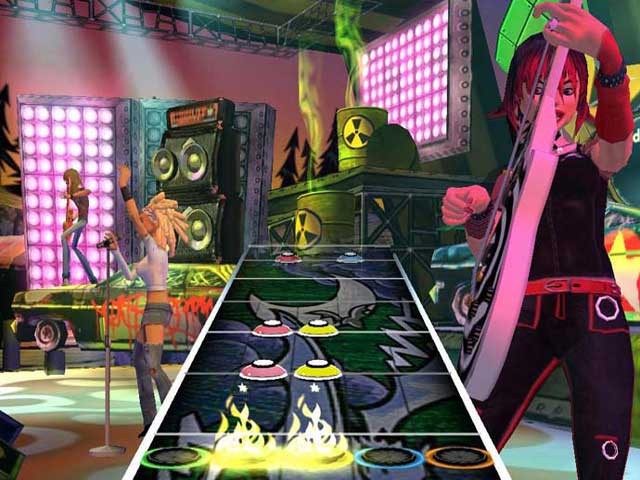
And this is a rad game. Musically inclined developer Harmonix has been building toward this release for several years. Frequency and Amplitude (criminally overlooked, that one) were both great rhythm games that broke the DDR mold and blistered countless fingers. Guitar Hero uses essentially the same interface: a long pathway along which scrolls a sequence of up to five different notes that players have to hit.
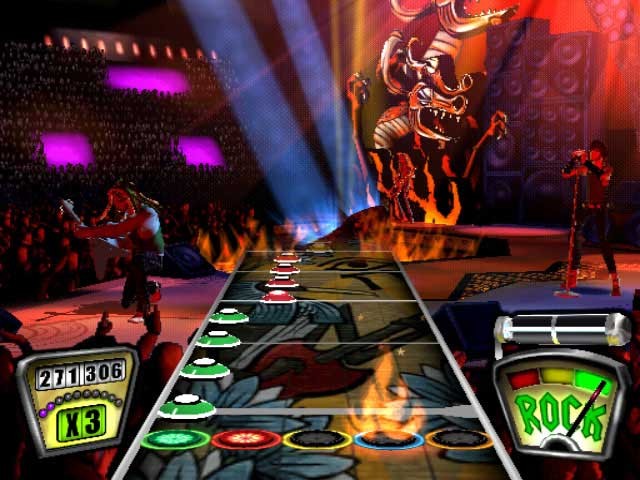
That pathway is actually a guitar neck. Packaged with the game is a plastic Gibson replica featuring five colored fret buttons, a strum bar and a whammy bar. Hold one or more frets, swipe up or down on the strum bar, and you’re rocking. Hit ten notes in a row for a multiplier bonus; keep the streak going to get higher scores. Up to five stars will be awarded based on score and the number of notes hit for each song. Stars earn cash, which can buy new characters, guitars and some decent bonus songs, mostly by indie Boston bands. (Hooray for the Upper Crust!)
Credit a great deal of the game’s approachability to the finely ramped difficulty. With no fuss, each song introduces something new and slightly more difficult. The main Career mode breaks up thirty core songs into groups of five, requiring that each group is conquered before moving on. Though mastering the increasing challenge is definitely part of the fun, the easier settings are just as entertaining because the basic gameplay is still there and there’s less need to concentrate on hitting a perfect line. You can lay back and play without freaking out too much, the soft rock approach to video gaming.
On easy mode, only three frets are used and you’ll almost never see more than one note at a time. Medium adds a fourth fret and chords, while Hard uses all frets and the ability to “hammer on” notes (notes played using the hand on the guitar neck instead of the one picking or strumming.) Expert mode is exactly that – you’ll play almost every note and be racing up and down the neck like a geeky Yngwie Malmsteen. It’s not really playing, but it sure feels like it.
Of course, it’s possible to push a song into overdrive. Nail a sequence of star-shaped note icons to fill up a power meter. If one of those star notes is held for a while, so much the better, since the whammy bar can then pump the meter full of juice. Lightning bolts and screeching pick slides mean the power is ready to go, which is activated by turning the guitar up so the neck stabs the sky. Yes, the stabbing is mandatory. The effect is a higher point multiplier and a crowd willing to overlook plenty of flubs, which can carry you over a tough solo. It also makes you look awesome.
 I suppose that effect is increased even more if you’re really into the song. While there was obviously an attempt to include certain classics (Motorhead’s ‘Ace of Spades’), the catalog seems chosen as much for the ability of each song to provide a variety of difficulties while being consistently entertaining. Despite a few notable omissions (no Van Halen?), the spectrum is nicely covered, spanning the likes of Joan Jett’s ‘I Love Rock and Roll’ to Pantera’s ‘Cowboys From Hell.’ And yes, Ramones songs really are that easy to play. True guitar heroes like Hendrix (‘Spanish Castle Magic’) are on board, too. And after all the heavy rock, the intricate challenge of Stevie Ray Vaughn’s ‘Texas Flood’ is refreshing. The song list isn’t perfect, but any qualms about the presence of comparatively weak bands like Sum 41 and Incubus should evaporate once the fun of playing their actual songs sets in.
All the tunes are covers, but Harmonix has enlisted an uncannily talented group of musicians to put the tracks to tape. The renditions are almost dead-on – down to effects and particular style – but the vocals are another thing. It sounds like Ozzy is singing for Helmet and ‘Killer Queen’ is just flat out weird. Still, the music conquers the quirks.
A few moments of loading and intro screens aside, anyone wielding the guitar won’t notice much about the graphics. Harmonix has decorated the scrolling fretboard differently for each of the eight characters, but the notes still stand out clear. Spectators, however, will notice a solid set of effects and animations. The cartoonish players look great and are shockingly adept at miming what’s being played. The drummer will even hit skins on time, which is more than most movies and music videos can claim. Slick graphics are little but window dressing in a rhythm game, but they’re here nonetheless.
Above all else, Guitar Hero underlines the gyp of “achievement” in most other video games. Typically, if you return to early challenges in other games, they’ve turned too easy because the in-game character has become stronger and faster. But when I breeze through formerly killer songs, it’s because I’ve gotten faster and better. Steve Vai was right – practice works!

That’s a rhythm game thing, of course, but Red Octane’s plastic peripheral really helps. It doesn’t slip on the floor like a cheap dance mat or register hits the wrong way like a bad bongo. The buttons are responsive and the strum bar works with lots of pressure or very little, making it quite accommodating. Best of all is the fact that they aren’t charging an arm and a leg for it, as the whole package retails at the modestly increased cost of $70. My only complaint is that activating star power can be difficult, although maybe I just need to really rock that stab a little better. There’s also the lack of wireless support, which would allow me to swing it around my shoulders like a hair metal showboat.
A standard PS2 controller can be used in lieu of the guitar (X and the shoulder buttons act as the frets and strumming isn’t necessary), but it’s not even vaguely the same. It will have to do in multiplayer, though, where two players can trade off licks and leads. Having an extra guitar will open the option to synchronize rocking motions (which should activate a bonus for ‘You’ve Got Another Thing Comin’), but the Dual Shock works in a pinch.
A few extra touches would be great. How about the ability to slow passages that are otherwise blisteringly fast? Even great guitarists slow down solos and other tricky bits sometimes to learn them, and I know for a fact that under the proper conditions (read: bourbon), time sort of slows down and it gets easier to play well. I swear. And what about the chance to freestyle or even play online?
That’s a wishlist in the most positive sense, though. I’ve already spent more time with Guitar Hero than just about anything this season, and it’s as entertaining as it was the first day. Harmonix has created a game that’s addictive, tougher than John Wayne’s sinew and, to be frank, simply rocks.
-
Pitch-perfect learning curve
-
Awesome guitar controller
-
You rock these songs
-
You have great fun doing so
-
Star power is touchy
-
My hands hurt
-
Wot, no (insert band name here)?